
How to Decide Between Braces and Clear Aligners
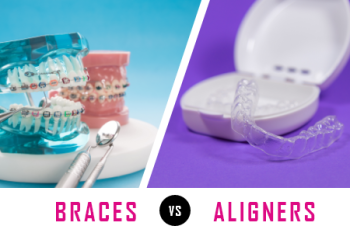 When considering orthodontic options, there are many pros and cons to weigh before making a decision. And like most choices, the decision varies from person to person depending on their oral health needs and the dentist’s recommendations. Here at Today’s Dental in Pineville will discuss the differences between braces and clear aligners and help you and your dentist decide what’s best for you.
Perhaps the most obvious difference between these two options is the most significant. While there are a variety of braces people can choose for cosmetic purposes, the fact is that braces can be seen whether we attach them to the front or back of the teeth. Meanwhile, clear aligners are close to unnoticeable plastic molds of a patient’s teeth. Ivory brackets are attached to the teeth to allow the aligner trays to slide effortlessly into place. This brings us to the next big difference…
- Braces are affixed, and aligners are removable
For stability and functionality, we secure braces to the patient’s teeth for the duration of treatment. Although this may be uncomfortable, it is a suitable alternative to losing them. The same cannot be said for clear aligners, which could be lost in any number of ways. And because of their near-invisibility, they can be as elusive as a missing contact lens. However, their removability is convenient for brushing and flossing, for certain social gatherings, or even for speaking engagements where clarity of speech is a factor.
- Braces are traditional, and aligners are advanced
Braces are the go-to treatment for many orthodontists, and it has been that way for decades. Despite that, braces have changed with the times, and today they are available in multiple varieties. Stainless steel braces are the standard, but they can also be gold-colored or tooth-colored ceramic to blend with the patient’s teeth. Clear aligners are the way of the future. They make dental treatment less conspicuous, and they are becoming the preferred method for today’s clinicians.
- Braces take time to adjust, aligners less so
When braces are applied, a bit of pain is to be expected at the beginning. They are slowly moving the bones and straightening your teeth. The wires and brackets attached to the braces can irritate the gums at the base of teeth or on the sides of the mouth. However, this is only temporary. Eventually, the mouth will adjust to these dental appliances to the point where a patient might forget they have braces in the first place. When it comes to aligners, a patient might be tempted to remove them due to the initial discomfort, but this is inadvisable because it will prevent the aligners from doing their job. By sticking it out, the patient will find that this onset of pain is easily manageable and will dissipate shortly. It is all for the greater good.
- Whether braces or aligners, always brush
Frequent brushing and flossing are a given when a person has braces. Make sure to remove all food debris and plaque buildup to keep teeth healthy. As for aligners, you must remove them when brushing and flossing, and teeth must be squeaky clean before reinserting them. With both braces and aligners, soda and sugary foods are to be avoided at all costs. If anything gets caught in either of these appliances, tooth decay could result. So, listen to your dentist and steer clear of sugary drinks and crunchy or chewy foods.
There is no ‘wrong’ choice for orthodontics. However, your dentist is best equipped to guide you in the direction that will be most appropriate for your specific issues. If you have questions and would like to learn more about orthodontic options, let us know! Contact Today’s Dental to schedule an appointment!
The content of this blog is not intended to be a substitute for professional medical advice, diagnosis, or treatment. Always seek the advice of qualified health providers with questions you may have regarding medical conditions.

Dr. Jonas E. Gauthier
Today's Dental


 , the image or video has been created in part by artificial intelligence models.